Helping students bridge the gap between abstract math concepts and real-world application is a challenge for any educator. Our latest dimensional analysis worksheet provides a structured way for learners to master unit conversion through logical, step-by-step problem solving.
This resource is designed to demystify the process of unit canceling, which is often the biggest hurdle for students moving into high school chemistry or physics. By utilizing a scaffolded approach, the worksheet guides the user through identifying given values and determining the necessary conversion factors. Rather than just memorizing formulas, students learn the underlying logic of how units behave like variables in an algebraic equation.
Why Every Student Needs a Dimensional Analysis Worksheet
The primary goal of this dimensional analysis worksheet is to teach students how to systematically change units while maintaining the integrity of the measurement. It breaks down complex, multi-step problems into manageable segments, effectively reducing the intimidation factor that often accompanies stoichiometry or physics calculations. By practicing with this resource, students build the mental framework necessary to navigate everything from simple metric conversions to advanced scientific calculations.
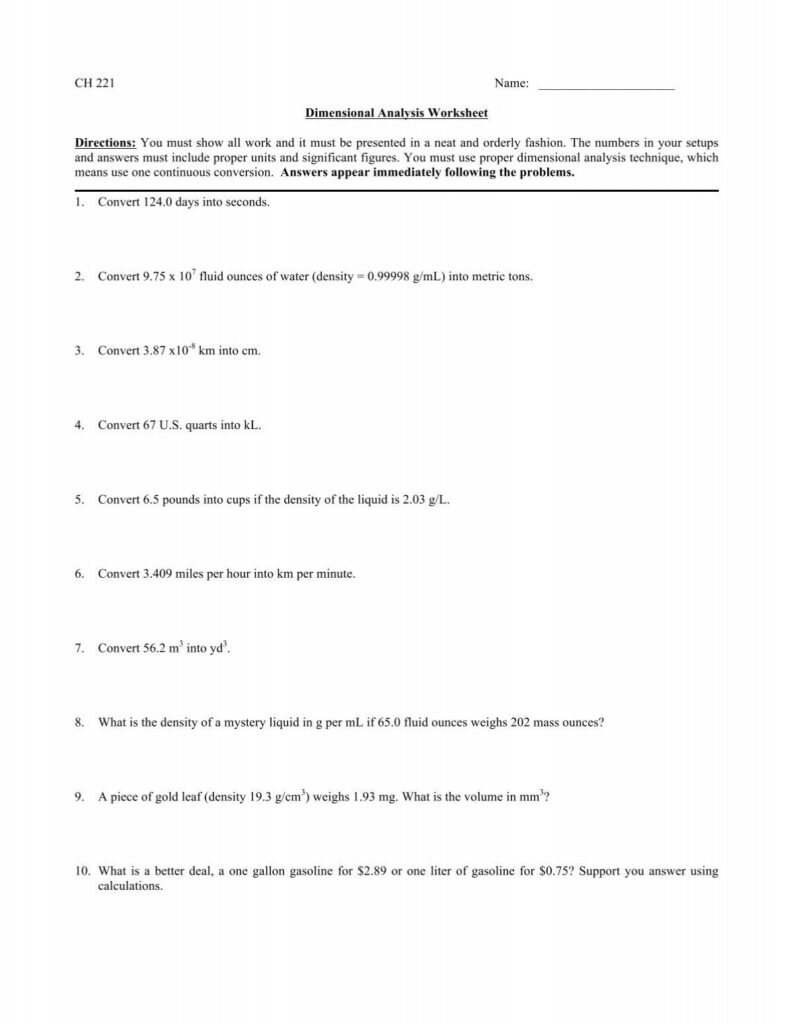
Students typically begin practicing this method in late middle school or early high school as they enter introductory science courses. It is perfectly suited for learners who struggle with mental math or those who often get lost in multi-step conversion processes. Because the sheet focuses on the process rather than just the final numerical answer, it serves as an excellent diagnostic tool for identifying exactly where a student’s logic might be breaking down.
Teachers can utilize these pages as a daily warm-up activity to sharpen recall, or as a homework assignment to reinforce the day's lecture. When used in a classroom setting, the worksheet encourages students to write out their units clearly, which is the gold standard for avoiding common calculation errors. Parents will find it equally useful for extra practice at home, especially when a child needs a few more examples to fully grasp the relationship between equivalent values.
Bringing Conversions to Life
To move beyond pen and paper, try pairing the worksheet with a kitchen-based challenge involving mass and volume. Ask your student to convert the ingredients of a recipe from ounces to milliliters, forcing them to apply their conversion factors in a tangible, high-stakes environment where a mistake leads to a strange-tasting snack. This type of experiential learning makes the abstract nature of dimensional analysis feel much more grounded and relevant to their daily lives.
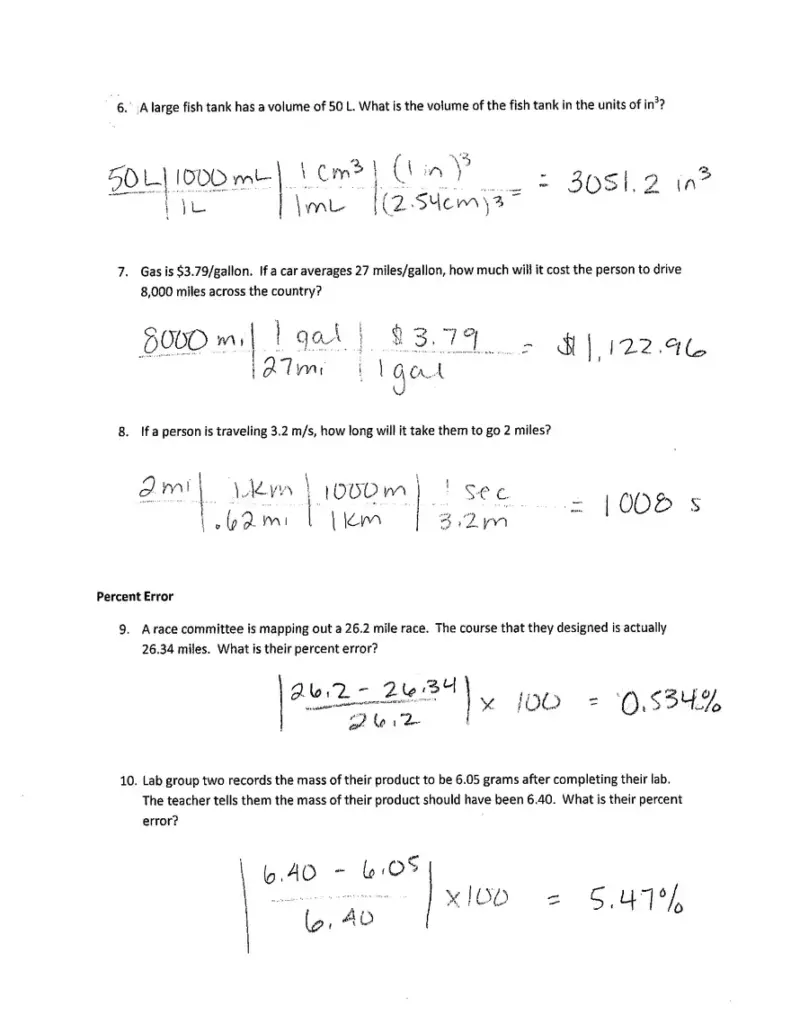
Another effective strategy is to create a matching game where students must pair a physical measurement with its converted equivalent. You can write different units of distance or time on separate cards and have the child race to complete a conversion chain using the labels found on the worksheet. This physical interaction helps them see that the units themselves are just as important as the numbers being multiplied or divided.
You might also consider incorporating a creative drawing task where students map out the distance they travel in a week, converted from miles to inches or even centimeters. Visualizing these large numbers helps them understand the scale of their work and reinforces why the canceling process is so vital for maintaining accuracy. By combining artistic expression with rigorous scientific notation, you provide a multi-sensory experience that caters to different learning styles.
As your child gains confidence with these steps, you will notice their hesitation when encountering word problems begins to fade. Developing a steady, disciplined approach to unit analysis is one of the most reliable ways to set them up for success in higher-level laboratory sciences. With consistent practice using these structured pages, they will transition from viewing math as a chore to seeing it as a powerful tool for solving genuine problems.